


Since 1991, the European Union has regularly updated and released new anti-money laundering directives to adapt to and be able to fight new money laundering and terrorist financing techniques (e.g.: MiCA to regulate crypto-currencies).
Today, modern technology services are becoming increasingly popular as alternative financial channels. However, some remain outside the scope of the law's requirements, which may no longer be legitimate. This is why an updated and evolving legal system is needed.
The latest directive in terms of AML is that of November 12, 2018 when the European Parliament issued new rules to strengthen the fight against money laundering through the 6th EU AML Directive (2018/1673) on the prevention of the use of the financial system for the purpose of money laundering or terrorist financing, thereby strengthening the 2018 AMLD5.

Member States had until December 3, 2020 to transpose the directive and bring into force the laws, regulations and administrative provisions necessary to comply with it.

Anti-money laundering is a set of procedures, laws and regulations designed to address practices related to income derived from illegal activities.
Why is anti-money laundering adoption an important issue for businesses?
A company has the responsibility to ensure that its financial transactions with stakeholders, shareholders and third parties are not linked to illegal actions. This practice allows the company not only to comply with legal provisions, but also to value the multiple aspects of the company (reputational, operational, financial, compliance risks).
What are the legal and regulatory compliance challenges?
This is a continuous new challenge for financial institutions and other regulated companies as local regulators no longer hesitate to impose huge fines and/or mandatory corrective measures in a relatively short time frame. Financial loss due to AML failures is no longer a residual risk and must be fully understood and integrated into every regulated entity. Anti-money laundering is a central theme in compliance. With the strengthening of controls by local and European supervisors, financial institutions need to ensure that they are compliant with anti-money laundering rules across all their departments, but also ensure through their regulatory monitoring that they are well informed on the latest issues from the EU, OFAC, FATF and local regulators. Awareness, as well as the pace of adaptation of new regulations, should be ensured by the management committee and by the accountability of the executives with a clear governance.
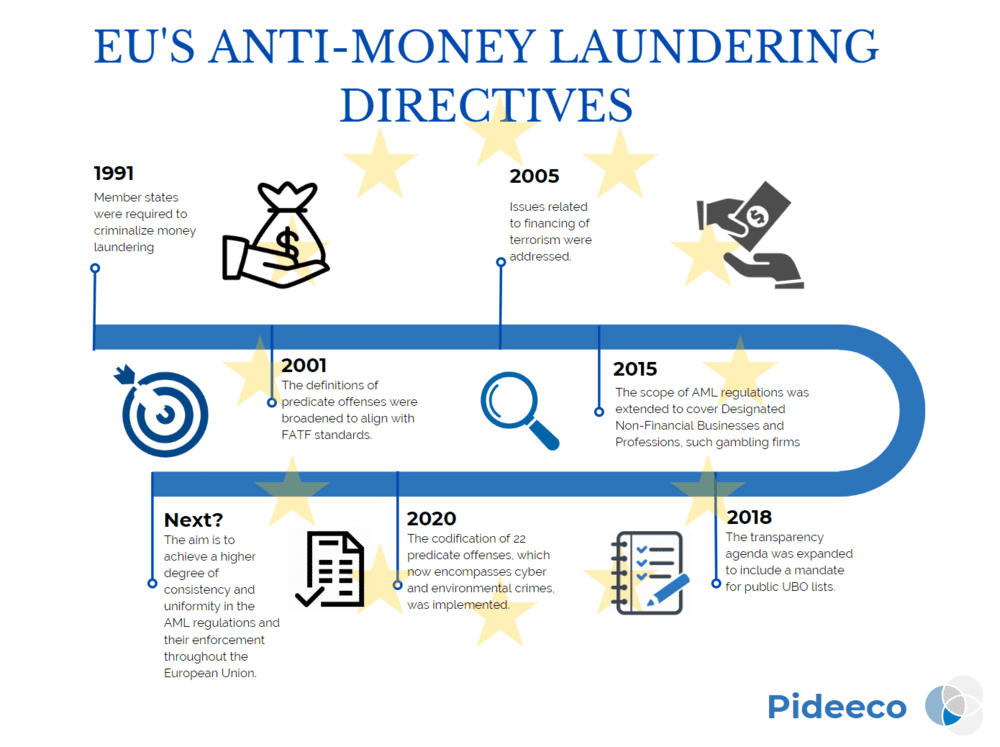
In 1990, the European Union adopted the first anti-money laundering directive to prevent the misuse of the financial system for money laundering. It stated that the entities concerned (banks and other entities subject to the obligation) should exercise customer due diligence (identification of customers, monitoring of transactions and reporting of suspicious transactions) before entering into and carrying out any commercial transaction.
In 2001, the 2nd Anti-Money Laundering Directive was unveiled as an updated and amended version of the 1st Directive in order to refine the existing provisions and fill in the gaps with the 40 recommendations suggested by the Financial Action Task Force (FATF), an intergovernmental organization founded in 1989 by the G7 to develop policies regarding the fight against money laundering. The main changes were as follows:
Determining which Member State authority should receive details of suspicious transactions
Adopt a broader definition of money laundering that is caused by an original crime (corruption, drug trafficking...)
Broaden the scope of application: previous entities + exchange offices, money transmitters and investment firms
Identify the authority responsible for searching, tracing, freezing, seizing and confiscating any property and proceeds related to criminal activities.
Since its adoption in 2006, the 3rd Directive has strengthened the European Union's anti-money laundering system. Changes have been made to :
Broaden the scope: previous entities + lawyers, notaries, accountants, real estate agents, casinos and including trust and company services, exceeding 15,000 euros.
Include measures regarding the financing of terrorism
Establish technical criteria to assess whether situations represent a low or high risk of money laundering or terrorist financing.
Implement enhanced customer due diligence measures for politically exposed persons (persons in public office) and their immediate family or close associates, as well as simplified customer due diligence procedures for low risk transactions.
The 4th Directive, which puts forth a risk-based approach to anti-money laundering, emerged in 2015. This approach assumes that money laundering and terrorist financing risks can take various forms. Thus, responses and measures cannot be uniform and must be tailored on a case-by-case basis. The following changes should be noted:
Adopt a broader definition of politically exposed persons: Foreign and local officials
Broaden the scope: previous entities + gambling service providers
Cash donations up to 3,000 euros
Establish a list of so-called "high-risk" third countries and exercise heightened customer vigilance when dealing with natural or legal persons established in these countries.
In January 2018, the Fifth AML/CAML Directive was adopted by the Council of the European Union and was transposed into the national laws of the individual Member States in January 2020. With the changing financial landscape and in particular the implementation of the General Data Protection Regulation, companies are facing new challenges.
The main changes introduced are as follows: |
|---|
Extension of the AML/CTF regulatory framework to virtual currencies, tax services and works of art |
Improving controls on transactions involving high-risk third countries |
Allow the use of electronic money products in an anonymous form only in two situations: a. Directly in store for a maximum amount of 50 euros b. Online for a maximum amount of 50 euros |
Establish a more transparent system of beneficial ownership |
Create a centralized bank register or information retrieval systems |
Strengthen the powers of EU financial intelligence units and facilitate their cooperation |
Strengthen cooperation between financial supervisors |
6 AMLD: the most recent directive
The objective of the new directive is to harmonize the European framework and to administer in all Member States effective, proportionate and dissuasive money laundering-related sanctions that cannot be sufficiently enforced by Member States alone. The 6th European Anti-Money Laundering Directive deals with 4 main points:
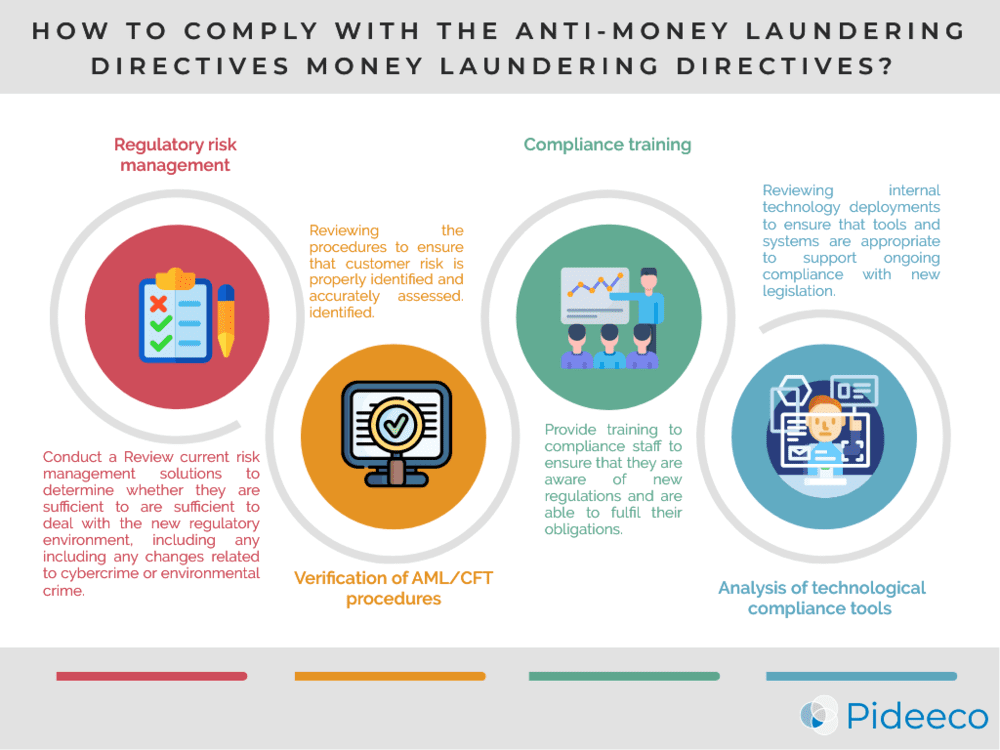
1. A more comprehensive definition of criminal activity The 6th AML Directive aims to harmonize EU anti-money laundering legislation by establishing a list of 22 criminal offences related to money laundering that all EU Member States must take into account. These include cybercrime, environmental and tax offences. Businesses must update their anti-money laundering and anti-terrorist financing programs to adapt to the risk environment defined by the directive and train their employees to detect suspicious activities related to the predicate offenses.
2. Liability and sanctions of legal persons AMLD6 extends criminal liability to legal persons (companies, integrated companies, etc.) as well as to natural persons in certain positions (person with power of representation of the legal person, with authority to make a decision on behalf of the legal person or to exercise control within it, etc.). Companies will have to review their internal control and governance mechanisms to avoid any violation.
3. Better international cooperation AMLD6 addresses the issue of dual criminality - the principle that a crime can be committed in one jurisdiction before its financial proceeds are laundered in another. The regulation establishes specific requirements for information sharing between jurisdictions, allowing for cross-border prosecution in Member States.
Revelations of grand corruption, such as the looting of state assets and misappropriation of public funds, have led to increased scrutiny of business relationships with PEPs . Financial institutions must take extra precautions when dealing with PEPs, as there is a higher risk that these individuals will use their position to engage in illicit activities, such as accepting bribes, misusing government resources and using financial systems to launder the proceeds of their crimes.

The establishment of investigative tools and rules will make it possible to determine which Member State will have jurisdiction when an infringement falls within the competence of several Member States. This will allow for more efficient and faster cross-border cooperation between Member States. In addition, the directive sets out a series of factors to be taken into account by authorities in deciding how and where to prosecute, including the country of origin of the victim, the nationality (or residence) of the offender and the jurisdiction in which the offence took place.
4. Strengthened punitive measures Punitive measures have been strengthened for individuals and some have been introduced for legal persons. Heavier prison sentences have also been introduced. Member States should ensure that they provide additional sanctions or measures such as fines, temporary exclusion from social assistance, temporary ban on commercial activities and ban on public employment. For organizations/legal entities, punitive measures include confiscation of business activities, exclusion from access to public funding or even judicial liquidation. Companies should consider strengthening their anti-money laundering and anti-terrorist financing efforts to reduce the risk of criminal prosecution.
What does the future hold for AML laws?
It is inevitable that the AML directives will undergo updates in the future to prevent new money laundering and terrorist financing techniques. One of the recent dangers concerns the use of crypto-currencies, which have not yet been clearly identified in the directive, as an open door to money laundering and terrorist financing.
Indeed, the traceability of funds can be complex due to, for example, coin mixers which are an effective tool for criminals to hide the origin of their cryptocurrency. The future concerning the laws against money laundering and terrorist financing will not be easy as new diverse and efficient techniques are being developed by criminals.

The objective of AML is to ensure that all the different possibilities of money laundering are regulated and properly analyzed. It would be important to be able to put in place a real analysis protocol concerning the different cases of money laundering and terrorism financing.