


In 2016, Panama Papers exposed a vast database of 214.000 offshore shell companies used by a variety of individuals and companies for tax evasion, money laundering, and corruption. The scandal sent shockwaves across the world, revealing the detrimental consequences of such entities for the global economy, and highlighting the urgent need for greater transparency and accountability.
The past financial data leaks unveiled by the ICIJ have disclosed close to one million shell companies used for illicit or murky purposes, but the ease and low cost of establishing such entities, coupled with the opacity that such corporate vehicles give to their beneficial owners, makes the problem ongoing and extensive.

Aside from money laundering, fraud, corruption, and other crimes, shell companies can have adverse effects over a country's economy and politics, including the loss of control of a nation's economic policies, the non-collection of taxes, and political instability.
The problem has been known for decades. In 2005, FinCEN's “U.S. Money Laundering Threat Assessment” noted that shell companies are prone to money laundering and other financial crimes as they are “easy and inexpensive to form and operate.” In 2006, the FATF report “The Misuse of Corporate Vehicles, Including Trust and Company Service Providers” painted a similar picture. Despite years of warnings, cases, and regulations, shell companies continue to be a recurrent headache in the fight against financial crime.
What is a shell company?
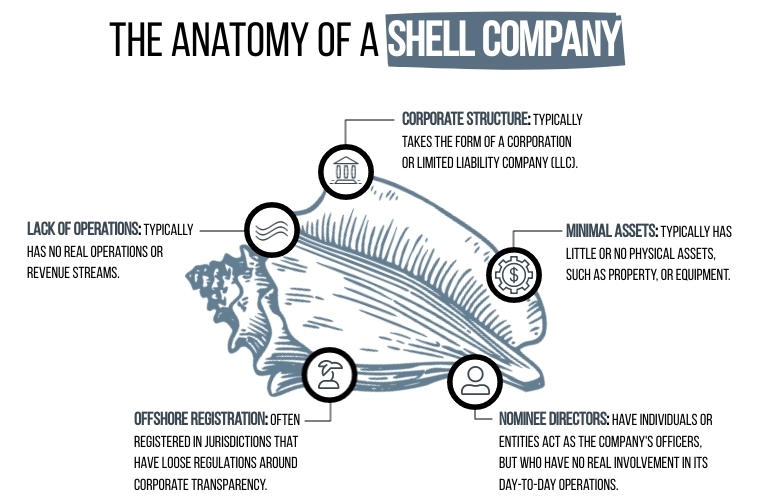
A shell company can be defined an entity that only exists on paper and lacks any active operations, resources, or personnel of its own. They have no physical office, with addresses usually linked to a mailbox, and are favored in countries with lax regulatory oversight or in tax havens.
Shell companies are not illegal, and their legitimate use includes raising funds, holding assets such as intellectual property, and keeping the negotiation of a merger and acquisition confidential. Many large corporations, such as Apple, have moved part of their operations to nations with looser tax legislation to protect their trademarks, a practice known as “offshoring.”

Setting up a shell company is relatively easy, requires only a few hours, and can cost between $100 to a few thousand dollars depending on the country where it is established and on the service used. The founder can appoint a strawman as the director of the company. Lawyers, notaries, and Corporate Service Providers (CSPs) are used to set-up such companies. They can also serve as directors for the entity, if needed. There are different types of shell companies. These include, but are not limited to:
Anonymous shell companies: the ultimate beneficial owner is concealed behind the corporation or a network of connected shell companies in other jurisdictions, providing anonymity and control over the company's resources. They are frequently connected to illegal activities.
Shelf companies: a type of company that has previously been incorporated but has never done business. It is kept until sold to a buyer who can use it to launch a new firm using an already-known company name, avoiding the process of starting a new corporation from scratch.
Special Purpose Entities (SPE): this type of company primarily engages in group financing or holding activities, with few employees and little physical presence in the host economy. Its assets and liabilities include investments made abroad and are frequently used for aggressive tax planning.
Letterbox companies: this type of corporation is registered in one state but operates in another. They can be used to get around labor rules of the nation where the activity is taking place.
Is Delaware a tax haven?
The state of Delaware in the U.S. can be considered a tax haven due to easy company formation, low taxes, and tight secrecy rules. For example, the address 1209 Orange Street in Wilmington is home to over 200.000 companies ranging from large corporations such as General Motors to anonymous shell companies.
Why are shell companies considered a money laundering risk?
The anonymity that shell companies offer makes them vulnerable to abuse by criminals and corrupt individuals. Such companies protect their privacy by keeping their owners' and controllers' identities a secret. They might use fictitious directors or shareholders, intricate ownership structures, and offshore jurisdictions with rules that permit greater anonymity and privacy. In certain jurisdictions, corporations are not compelled to divulge the names of their directors or shareholders.
This produces a Know Your Customer (KYC) nightmare as financial institutions are required to identify all beneficial owners of legal persons. The use of strawmen and third parties to carry out transactions and paperwork on behalf of the shell company makes the identification of the real UBOs highly difficult.
Shell companies may also add layers of ownership to conceal the underlying structure. With the use of a complex network of shell companies, trusts, and other entities as owners of the company, it makes it challenging for authorities and compliance experts to trace the ownership chain. It becomes even tougher when the companies are registered in different jurisdictions. Investigations by part of the authorities can be greatly hampered if the shell company is registered in a country that has no bilateral Mutual Legal Assistance Treaty (MLAT) with the jurisdiction of the authority conducting the inquiry. This makes obtaining records impossible. Even if a MLAT is present, the production of documents can take weeks to years, allowing the criminals to disappear.
How are shell companies used for money laundering?
Shell companies can be used during all three stages of the money laundering process. In the placement stage, where illegal funds are introduced in the financial system, shell companies can provide a way to deposit cash or transfer money without disclosing the money's true source. A criminal might, for instance, establish a shell business in a tax haven and utilize it to receive financial deposits that can subsequently be moved to additional shell businesses and then to bank accounts in different nations. In the layering stage, criminals may use myriads of shell companies across multiple jurisdictions to create chains of confusing transactions meant to hide the source of funds. In 2022, Transparency International an intricate global network of over 130 businesses that transferred more than $820 million out of Russia between 2014 and 2016. It was uncovered that Russian shell companies conducted 123 different transactions with businesses incorporated in the UK, Cyprus, and the Czech Republic for the purchase of non-existent bottle-moulding machines bought at 800 times their market price. The ultimate destination of the funds of this trade-based money laundering scheme remains unclear. The final integration stage sees criminals use shell companies to reintroduce into the economy the laundered funds to invest in luxury goods or to purchase high-value items. They can be used by criminals to enjoy the profits of their illegal activities without attracting attention. For example, a criminal could use a shell company to hide their identity when buying a luxury yacht or expensive real estate.
Shell companies and other financial crimes
Shell companies can also be used for a variety of other financial crimes. Rich individuals or entities often hide their wealth in shell corporations constituted in tax havens to commit tax evasion. It is estimated that around 70% of large-scale corruption cases involve shell companies that were used to hide the identity of the perpetrators. Shell companies, in conjunction with shipping entities, were also found to finance prohibited nuclear technology and exchange embargoed dual-use goods with other ghost companies.
What is the legislation concerning shell companies?
In the EU, the 4th and 5th AML directives required central beneficial-ownership registers. The CJEU judgment of 22 November 2022 (Joined Cases C-37/20 and C-601/20, WM and Sovim) invalidated unrestricted public access to UBO registers. The framework now moves to Regulation (EU) 2024/1624 (applies 10 July 2027) for harmonised CDD and UBO duties, and to Directive (EU) 2024/1640 (AMLD6) for registers: Articles 11, 12 and 13, with partial transposition by 10 July 2026, and BARIS interconnection of account registers by 10 July 2029. The Regulation (EU) 2023/1113 strengthens transfer traceability against cascade structures. See also the AML package / AMLR, EWRA, the Belgian UBO register and EU AML directives.
Internationally, FATF Recommendation 24 was strengthened in 2022; the March 2023 FATF guidance on beneficial ownership of legal persons clarifies the multi-pronged approach. In the US, the Corporate Transparency Act (FinCEN rule) requires UBO reporting to FinCEN for many companies formed under US law.
Operational CDD red flags
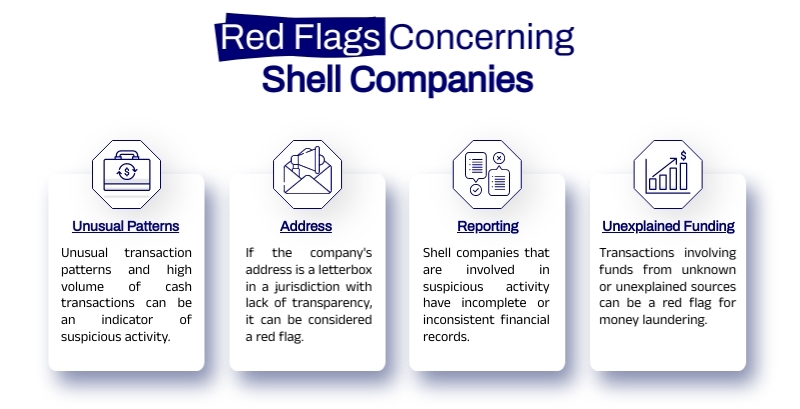
Opaque, multi-jurisdictional ownership with no credible economic activity.
Nominee directors or shareholders; an address shared with hundreds of other entities.
UBO missing or inconsistent with the national register / open sources.
Flows without commercial counterpart, overvalued goods, or rapid chains of companies.
Links to higher-risk sectors (real estate, trade, company services) without documented rationale.
Transparency as a global priority
Shell-company regulation remains a priority for supervisors and the FATF. For obliged entities, the task is to evidence defensible CDD on the UBO, aligned with AMLR 2027 and the 2025-2026 UBO deadlines. For company KYC, see how to conduct KYC on companies.